Fred Wright
Anne of AvonleaFred Wright enters the story through a scene Anne Shirley happens upon in the Barry garden: he and Diana Barry are together beneath a willow, privately absorbed in one another. Their engagement, disclosed the following evening, is a decisive step into adult life for Diana and a moment of change for Anne, who must reckon with the possibility that her closest friend is moving into a world they will not share in quite the same way.
Identity and Introduction
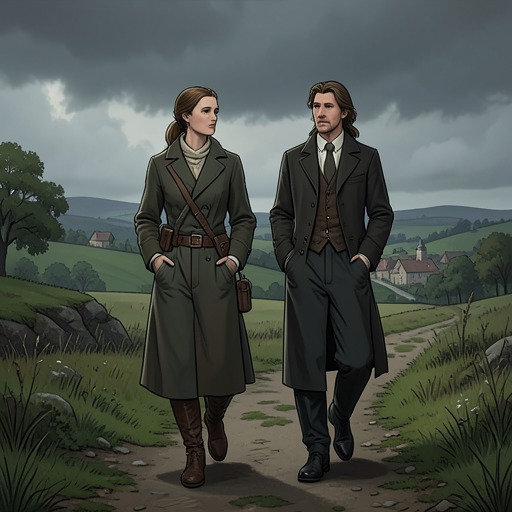
The account offers Fred chiefly as Diana’s beloved and fiancé, not as a separately developed viewpoint character. Anne sees him standing with Diana beneath the large willow in the Barry garden, reached from Orchard Slope by the wood cut. Diana leans against the gray trunk, her lashes lowered and her cheeks flushed; Fred holds one of her hands, bends toward her, and stammers in low, earnest tones. The private intensity of the moment is clear, although Anne cannot hear what he is saying.
Neither Diana nor Fred notices Anne. After one startled glance, she slips back through the spruce wood and hurries to her room at Green Gables. Her discovery converts what had been suspicion into knowledge: Diana and Fred are in love. Fred’s first appearance is therefore mediated by Anne’s accidental witnessing, and the reader initially encounters him as part of a relationship already underway rather than through an introduction or account of his past.
Engagement and Its Conditions
The next evening, Diana visits Anne in the east gable and tells her the whole story. The girls cry, kiss, and laugh together, but Diana’s happiness is accompanied by disbelief at being engaged. She describes the match as delightful because it is Fred she is to marry, making the attachment personal rather than a general enthusiasm for marriage. Anne, who has not yet had this experience, asks what being engaged is like; Diana answers from the particularity of her own feelings, which Anne recognizes through her ability to imagine life from another person’s point of view.
The engagement is not presented as an immediate wedding. Diana is eighteen, and her mother will not permit a daughter to marry before twenty-one, so Diana expects at least three years to prepare. Fred’s father also intends to buy the Abraham Fletcher farm for him, but requires it to be two-thirds paid for before it is put in Fred’s name. His future household is thus tied to a practical financial threshold as well as to the couple’s affection. The narrative gives no further account of Fred’s plans or response to these conditions, but the arrangement makes clear that their commitment still awaits time and material preparation.
Diana turns that preparation into a concrete domestic project: she intends to begin crocheting doilies the next day and wants to make thirty-seven, the number Myra Gillis had when she married. Anne teases that thirty-six might surely suffice, and Diana takes the joke amiss. This exchange places Fred’s engagement within Diana’s ideas about becoming a housekeeper, while also showing how the prospect of marriage changes the subject of conversation between the two friends. The household preparations belong to Diana’s account; the text does not describe Fred directing or sharing them.
Relationship with Diana and Anne
The willow scene establishes Fred and Diana’s intimacy through gesture rather than exposition. Diana leans against the tree while Fred holds her hand and tries to speak; their absorption in each other makes them seem, to Anne, alone in the world. That private closeness is confirmed when Diana later confides in Anne and identifies Fred as the person who makes engagement seem lovely. The narrative thus gives Fred a distinct importance in Diana’s emotional life without supplying his own account of their courtship.
For Anne, the discovery first brings a small, unexpected loneliness. She had suspected that Diana’s childhood fantasies about a melancholy hero were giving way to a real attachment, but seeing the couple makes the change undeniable. Anne worries that Diana may move into a new stage of life and that she may no longer be able to share every secret with her friend, especially if Fred might hear them. Yet the next evening’s confidence and their tears, kisses, and laughter show their closeness continuing: Diana tells Anne the whole story and asks her to be her bridesmaid, wherever Anne may be when the wedding takes place. Anne solemnly promises to come even from the ends of the earth.
Narrative Role and Limits
Fred’s engagement helps make change visible through an intimate, ordinary scene rather than a public announcement. Anne’s accidental glimpse supplies the first proof; Diana’s subsequent confidence turns that visual discovery into a shared conversation about love, marriage, and growing up. The contrast is important: Anne initially experiences Diana’s new attachment as a possible gate closing between them, but Diana’s request that she stand beside her at the wedding carries their friendship forward into the future being planned.
The promise remains prospective in the account. Diana anticipates a wedding no sooner than three years away, and Fred’s farm arrangement is still conditional; no wedding or later married life is described here. The text also leaves Fred’s private thoughts largely unstated. His character is defined in these scenes by the earnest, stammering approach Anne witnesses, by Diana’s happiness with him, and by the practical future attached to their engagement. That limited presentation keeps the emphasis on the change in Diana and Anne’s friendship while giving Fred the central place in Diana’s chosen future.